












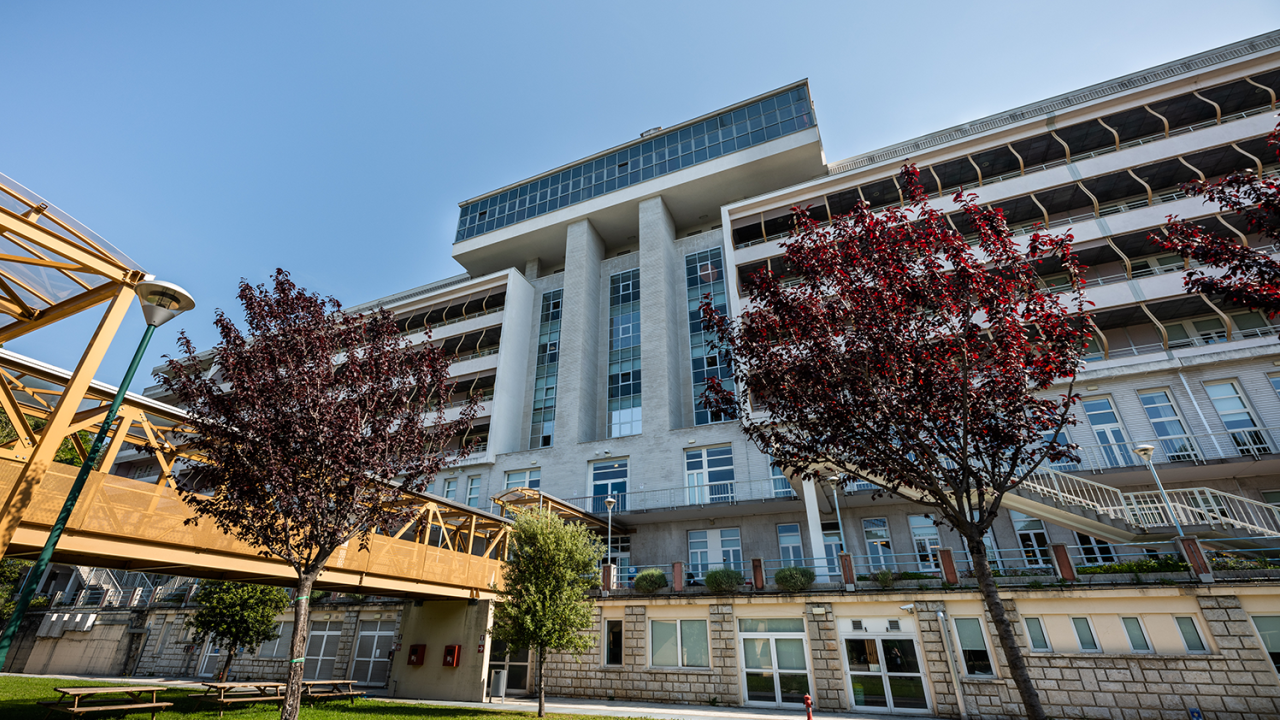
SISSA – Scuola Internazionale Superiore di Studi Avanzati – was founded in 1978 and is a public higher education institution and scientific center of excellence within the national and international academic scene. Located in Italy, in the city of Trieste, it features about 70 professors, 130 researchers, 300 PhD students and 120 technical administrative staff. Situated on the scenic Karst upland, the School is surrounded by a 25 acre park, and offers a stunning view of the Gulf of Trieste.
SISSA’s activities focus on three main areas: Physics, Neuroscience and Mathematics. Moreover, the Interdisciplinary Laboratory works at the interface between science, humanities and the public.
All the scientific work carried out by SISSA researchers is published regularly in leading international journals with a high impact factor, and frequently in the most prestigious scientific journals such as Nature and Science. The School has also drawn up over 150 collaboration agreements with the world's leading schools and research institutes.
The quality level of the research is further confirmed by the fact that within the competitive field of European funding schemes SISSA holds the top position among Italian scientific institutes in terms of research grants obtained in relation to the number of researchers and professors. Such leadership should also be seen in terms of SISSA's ability to obtain funding, both from the private and public sectors, such as PRIN.
At SISSA, scientific discovery begins with the freedom to explore, time to think, and recognition of the need to engage with society. It is a place where ideas are developed with rigour, curiosity, and openness to different perspectives.
SISSA’s mission is defined by advanced postgraduate training and frontier research across three interconnected areas: Mathematics, Neuroscience, and Physics.
Its Interdisciplinary Laboratory for Natural Sciences and Humanities fosters both dialogue across cultures and public engagement. Technology transfer activities strengthen ties with social and economic partners.
PhD students at SISSA are involved in research from the very start. The training path combines high-level coursework in the first year with increasingly independent research activity, culminating in the publication of original scientific work. Admission is through a yearly exam in Trieste or online, with a preselection process for non-EU candidates. The four-year program ends with a final exam for the PhD degree, equivalent to the Italian “Dottore di ricerca”, across 12 courses in Physics, Mathematics, and Neuroscience. PhD students at SISSA are supported in developing transversal skills such as scientific communication, data management, and entrepreneurship, within an environment that encourages regular interaction with supervisors and postdoctoral researchers.
Programs include:
- 7 PhD programs in Physics
- 2 PhD programs in Mathematics
- 3 PhD programs in Neuroscience
- 3 postgraduate courses in Science Communication, High Performance Computing, and Data Management and Curation
SISSA carries out both basic and applied research in three main areas: physics, mathematics and neuroscience. Each faculty member leads independent projects as Principal Investigator, often in collaboration with PhD students and postdocs. SISSA ranks in the highest positions among the Italian scientific institutions in terms of awarded European Research Council grants considering the small faculty size, and is consistently among the top Italian institutions in securing all types of competitive funding, both international and at the Italian level, such as the National Recovery and Resilience Plan (PNRR) and PRIN (Progetti di Ricerca di Interesse Nazionale) funding schemes.
SISSA is part of the Italian system of Scuole Superiori ad Ordinamento Speciale, a small group of public institutions recognized for their excellence in research and advanced education. Unlike traditional universities, SISSA offers only PhD, postdoctoral training and post-graduate courses. In addition of this, it collaborates with other universities in undergraduate and master courses. Being a Scuola Superiore gives SISSA greater autonomy in governance and academic planning, allows for an intense research-focused academic life and a close mentoring relationship between students and faculty. Around 50% of the School’s budget is directly allocated to research—five times more than the national average.
SISSA was the first institution in Italy to award the title of PhD, introduced in 1978 and officially recognised as equivalent to the national doctorate in 1987. Courses are held in English and the School’s community is highly international, with around one third of students and half of postdocs and faculty coming from abroad. SISSA played a key role in shaping open access scientific publishing, establishing one of the first online preprint archive and launching in 1997 JHEP - The Journal of High Energy Physics, the first fully electronic open access journal. Today, editorial activities continue through SISSA Medialab, an in-house company focused on academic publishing and public engagement. The School has also been a pioneer in the field of science communication. Founded in 1994, the Master’s in Science Communication “Franco Prattico” is one of the first training programs of its kind worldwide. It is the oldest school for science communication in Italy and shares this distinction in Europe with Imperial College London.
SISSA is open to international collaborations and has scientific agreements with more than a hundred of institutions. In addition 10% of the permanent staff, 50% of the post-docs and 33% of the PhD students come from other countries.
- SISSA adopts an integrated strategic planning system that ensures alignment between long-term vision and day-to-day operations. The School’s commitment to transparency, accountability, and continuous improvement is supported by four key documents:
- Strategic Plan – Outlines SISSA’s long-term priorities in research, education, and institutional development, providing the framework for future growth and impact.
- Three-Year Planning Document – Defines goals and actions to ensure ethical conduct, transparency, and integrity in all administrative and decision-making processes.
- Performance Report – Evaluates the outcomes achieved in relation to set objectives, fostering internal assessment and performance-based governance.
- PIAO (Integrated Plan of Activities and Organization) – Combines strategic planning, HR forecasting, performance targets, and organizational measures into a single document to improve operational efficiency and transparency.
At SISSA, innovation means transforming fundamental research into real-world impact.
The School draws a bridge between academic studies and ready-to-use solutions through dedicated knowledge transfer activities, by promoting strategic collaborations with public and private agencies, SMEs, and industry. This commitment has yielded remarkable results, including 9 spin-offs in AI, computational simulations and neuroscience technologies, alongside over 10 active patents in these fields.
Key initiatives like “PhD4Innovation” aim to structurally connect PhD training with external leading innovation actors, fostering an entrepreneurial mindset and creating long-term value for all stakeholders.
SISSA’s Interdisciplinary Laboratory for Science and Humanities (ILAS) mission is to create a space where science, the humanities, and the arts can engage in dialogue with each other and with society, to imagine, inspire, and shape a shared future. The Laboratory takes part in several European projects on science communication and public engagement, while also developing collaborations with Italian and international public and private institutions. ILAS organizes the National Conference on Science Communication and the science book festival “Scienza e Virgola”.
Through its in-house company, SISSA Medialab, SISSA publishes and manages seven prestigious international journals covering the frontiers of physics and science communication, as well as a proceedings open access publishing platform. Since their inception, the journals have been at the forefront of technological innovation and open science. Their commitment to excellence is reflected in editorial boards composed of world-renowned, active experts, a rigorous peer-review process, and a strong commitment to open access.