













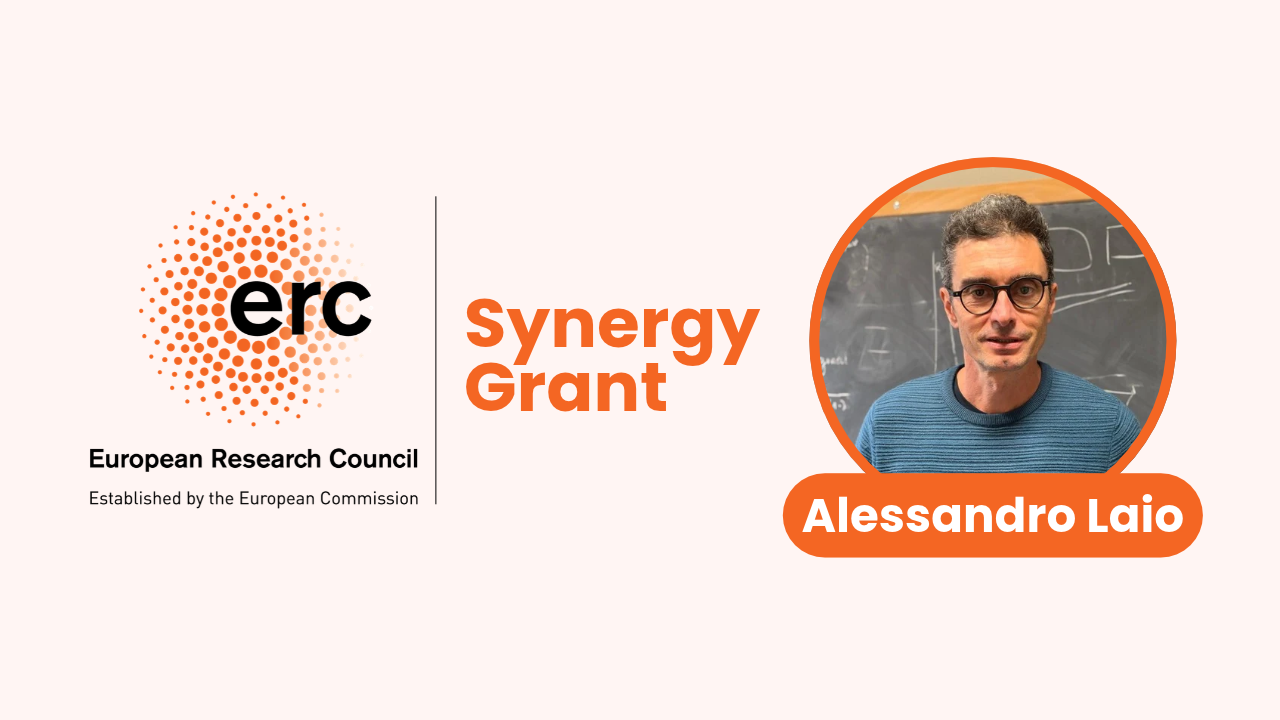
Alessandro Laio of SISSA has been awarded €2.5 million through an ERC Synergy Grant for a project investigating how modern deep neural networks, and large language models in particular, represent and organise the meaning of texts and images internally.
In addition to Alessandro Laio, the project will involve Matthieu Wyart of EPFL in Lausanne and Marco Baroni of Universitat Pompeu Fabra in Barcelona. The research team as a whole will receive a total of €10 million in funding.
European Research Council (ERC) grants are among the most prestigious and competitive research awards in Europe. Synergy Grants, in particular, support groups of researchers who bring together complementary expertise to address scientific questions whose complexity requires collaboration between leading experts.
This year's selection process was particularly demanding: only 48 of the 957 proposals submitted were awarded funding, representing just 5%.
The winning project: “Deciphering convergent representations in deep neural networks”
The six-year project, entitled “Deciphering convergent representations in deep neural networks”, aims to understand how modern deep neural networks, and large language models in particular, internally represent the meaning of what they read or see.
“To understand this, we start from a surprising observation,” Alessandro Laio explains. “When an artificial intelligence system is presented with content that conveys essentially the same meaning – for example, a sentence and its paraphrase, the same sentence translated into another language, or an image and its description – the internal representations produced by the network tend to become increasingly similar. We have developed techniques that allow us to isolate this common component. This makes it possible to obtain an explicit numerical representation of what we humans would call ‘meaning’.”
The project will investigate the properties of this shared representation, with the aim of developing a kind of geometric theory of meaning. “For example, we will try to understand whether networks break meaning down into basic concepts, as we humans do,” Laio continues. “At the same time, we will develop theoretical models and controlled artificial languages to study how these representations emerge during the learning process.”
Contributing to more interpretable and transparent AI
The ultimate goal is to achieve a quantitative understanding of the principles through which neural networks encode and combine meaning. Beyond its fundamental contribution to the study of language and artificial intelligence, the project's findings could help make AI systems more interpretable and transparent and, in the longer term, easier to control and safer.
Alessandro Laio comments on the achievement: “I am very happy about this opportunity offered by the European Union, which will allow my colleagues and me to work on topics at the intersection of theoretical physics, data science and the humanities. We hope to help open up the ‘black box’ of artificial intelligence systems by studying them ourselves, rather than leaving them to study us.”
The Director of SISSA also comments: “This is a thoroughly deserved recognition in a strategic field – artificial intelligence – which will be central to some of the most important challenges of our future.”
The grant awarded to Alessandro Laio brings the total number of ERC grants secured by SISSA researchers to 34.